The Challenges of Sourcing Indian Terry Towels: How the UK and EU Trade Agreement Changes the Game

On this page
Terry towels may look like a simple commodity product, but sourcing them can be pretty challenging.
For importers in the UK and Europe, every sourcing decision involves balancing multiple variables: product quality, cotton prices, manufacturing reliability, freight costs, sustainability requirements, and increasingly, trade policies.
India has long been one of the world's most important sourcing destinations for terry towels. The country offers abundant cotton, vertically integrated manufacturing, and decades of export expertise. Yet despite these strengths, sourcing from India has not always been straightforward.
Trade barriers, logistics disruptions, and rising compliance expectations have created challenges for both suppliers and buyers.
Now, that equation is beginning to change.
With the UK-India trade agreement in place and the EU-India Free Trade Agreement negotiations concluded, Indian terry towels are becoming more competitive than ever before, opening up new sourcing opportunities for importers across Europe.
The India-UK FTA came into force on 15 July 2026, eliminating tariffs on 99% of Indian exports to the UK.
Here's what UK and EU importers should know before sourcing terry towels from India.
Terry Towels from India to the UK and EU: Market Size and Opportunity
The UK and EU are among the largest import markets for terry towels and cotton bath linens in the world.
According to the Centre for the Promotion of Imports (CBI), Germany and France each account for roughly 15% of Europe's cotton toilet and kitchen linen imports, while the Netherlands contributes another 11% as a major re-export hub.
In 2024, EU imports of terry towels crossed $1.04 billion, highlighting the sheer scale of demand across the region.
India is already a well-established sourcing destination for these markets.
Trade data shows that India exported terry towels to more than 120 countries, with 23,559 shipments recorded between June 2024 and May 2025, growing by approximately 11% year-on-year.

Why UK and EU Buyers Prefer Indian Manufacturers
Vertical Integration
India's textile ecosystem is highly integrated. Many manufacturers manage spinning, weaving, dyeing, cut-and-sew, packaging, and compliance under one roof. This creates better visibility, more predictable lead times, and tighter quality control.
Large manufacturers such as Welspun, Trident and Himatsingka operate global-scale facilities and supply retailers across dozens of countries.
Product Innovation
Indian manufacturers have steadily moved beyond low-cost manufacturing. Today, buyers can source premium bath towels, organic cotton ranges, hotel-grade towels, and private-label collections from Indian suppliers.
Indian terry towels imported into the UK commanded an average import value of US$6.32 per kilogram in 2024, indicating strong buyer confidence in India's value-added offerings.
Retail-Ready Manufacturing
Some of Europe's largest retailers already source extensively from India.
Marks & Spencer, Primark, NEXT, H&M Home, IKEA, and Zara Home all maintain sourcing networks in India.
This means Indian manufacturers are already familiar with the quality, sustainability, and compliance expectations of global retailers.
Challenges for UK and EU Importers
Price Volatility
Cotton remains the backbone of terry towel manufacturing. Fluctuations in cotton and yarn prices can quickly influence manufacturing costs and supplier quotations.
Buyers working with long-term sourcing programs need suppliers who can absorb cost fluctuations without compromising on quality.
Logistics and Freight Disruptions
Global supply chains remain vulnerable to disruptions.
The Red Sea crisis significantly disrupted Asia-Europe shipping routes. As vessels were diverted around the Cape of Good Hope, transit times increased by approximately 10 to 14 days, while freight costs rose sharply across Asia-Europe trade lanes. These disruptions forced buyers to rethink inventory planning, sourcing strategies, and lead times.
As a result, buyers increasingly prioritize suppliers who can offer flexible shipment schedules, maintain buffer inventory, and provide greater visibility into production timelines.
Compliance and Sustainability
Compliance is no longer a box to tick after a deal is signed. European retailers increasingly expect factory-level transparency, environmental disclosures, social audits, and traceability across the supply chain.
Suppliers selling into Europe must comply with EU REACH regulations governing chemicals used in dyes, finishes, and packaging. Similarly, UK REACH governs the use of chemicals in textile products sold in Great Britain.
Buyers also increasingly look for certifications such as:
OEKO-TEX Standard 100
GOTS for organic cotton products
amfori BSCI
SEDEX SMETA
Tariff Structures and Market Access
Perhaps the biggest challenge for UK and EU buyers sourcing from India has historically been tariffs.
For years, Indian manufacturers offered world-class quality, large-scale production, and vertically integrated operations. Yet buyers often had to account for import duties that made Indian products less competitive compared to suppliers benefiting from preferential trade agreements.
This meant sourcing decisions were not always based solely on product quality or supplier capability. Landed cost often became the deciding factor.
That has now changed.
The UK-India trade agreement grants zero-duty market access for textiles and clothing, removing a longstanding disadvantage for Indian exporters.
Similarly, the EU and India concluded FTA negotiations in January 2026, with both sides highlighting substantial tariff liberalization for textiles. The deal is expected to go live by January 2027.
While the agreement is awaiting legal review and ratification, it has the potential to improve India's competitiveness in the European market significantly.
For buyers, this means that sourcing decisions can increasingly be based on what matters most: supplier reliability, product quality, innovation, and long-term partnerships.
How the UK and EU Trade Agreements Change the Game
The trade agreements are not just reducing tariffs. They are changing how buyers evaluate India as a sourcing destination.
With improved market access, buyers gain access to:
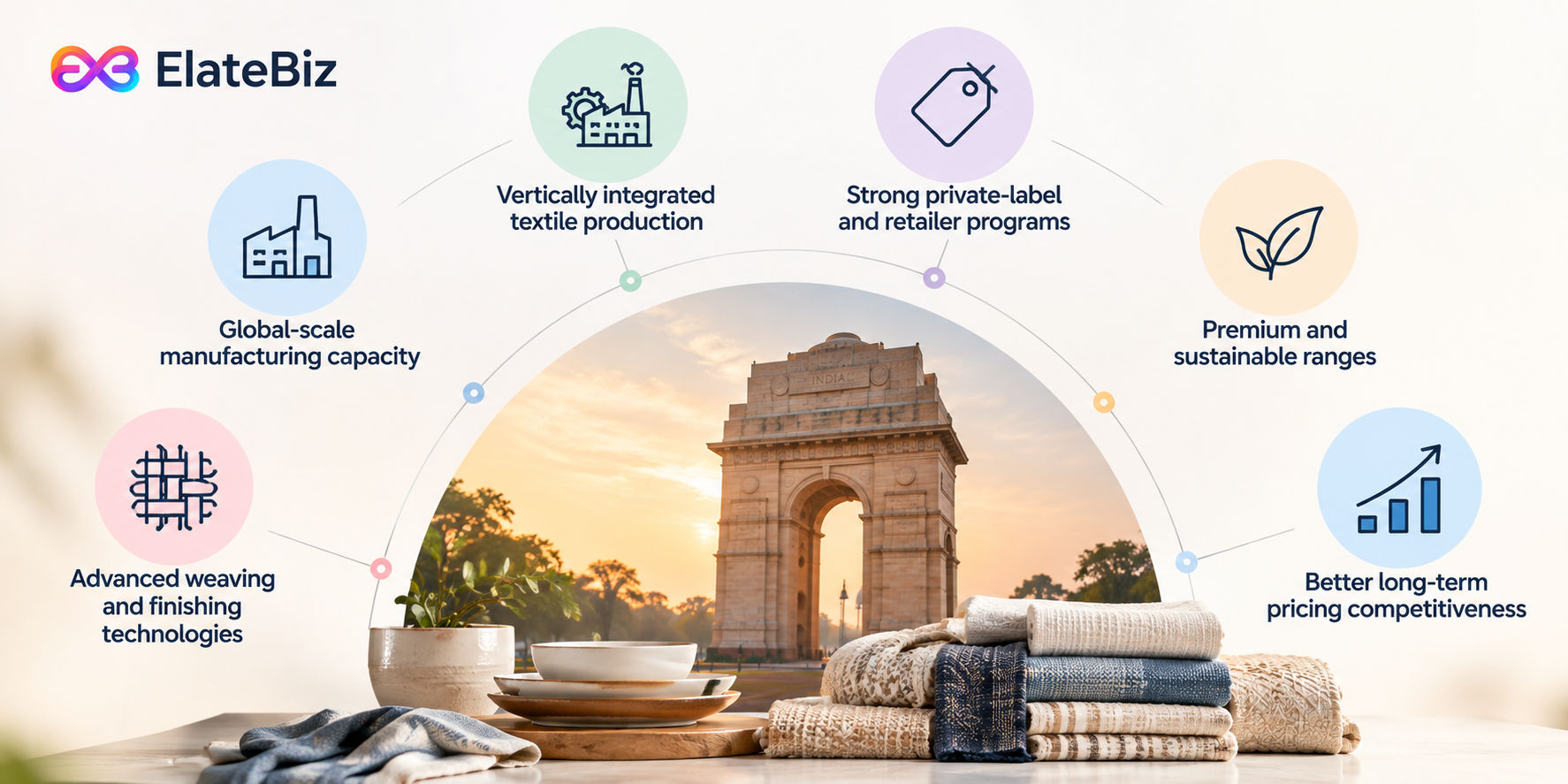
Global-scale manufacturing capacity
Vertically integrated textile production
Strong private-label and retailer programs
Premium and sustainable product ranges
Advanced weaving and finishing technologies
Better long-term pricing competitiveness
For importers looking to diversify sourcing and build resilient supply chains, India is increasingly becoming a strategic sourcing partner rather than just another manufacturing destination.
Conclusion
Sourcing terry towels in 2026 is about much more than finding the lowest FOB price. It is about balancing cost, quality, compliance, logistics resilience, and long-term competitiveness.
India already offers a mature manufacturing ecosystem, global retail experience, and extensive product innovation. With the UK and EU trade agreements improving market access, the country is now better positioned than ever to serve importers across Europe.
At ElateBiz, we help UK and EU buyers connect with vetted Indian manufacturers, manage supplier due diligence, and build transparent, reliable sourcing programs tailored to their business goals.
Looking to source terry towels or other home textiles from India? Work with the right sourcing partner.